

Members of the the Chesapeake Bay Program’s Executive Council, chaired by Maryland Governor Wes Moore, voted to approve the revised Chesapeake Bay Watershed Agreement. Photo by Joe Andrucyk, Office of the Governor.
Governor Wes Moore today led the Chesapeake Bay Program’s Executive Council in approving the revised Chesapeake Bay Watershed Agreement, which includes goals that will improve the health of the Chesapeake Bay, increase access to nature, and support livelihoods that depend on this nationally treasured resource. The revised agreement supports the environmental and economic future of the Chesapeake Bay, which in Maryland alone generates $3.2 billion and 58,000 jobs a year in tourism and supports the 3,300 jobs in the state’s seafood industry that nets $600 million annually.
“Today we made a commitment to the Chesapeake Bay and a commitment to the people of Maryland and our neighboring states,” said Gov. Moore. “The revised Chesapeake Bay Watershed Agreement will make our rivers and streams cleaner. It will bolster Maryland’s seafood, tourism, and recreational businesses. Most importantly, it will ensure we protect the precious heirloom that is the Chesapeake Bay so we can pass it down to the next generations in a better condition than we received it.”
Representatives from the Chesapeake Bay’s six watershed states—Maryland, Virginia, Pennsylvania, Delaware, West Virginia, and New York—as well as from the EPA, the Chesapeake Bay Commission, and Washington, D.C., reached consensus on the new agreement earlier this year, following more than two years of work with scientific advisors, community representatives, and Chesapeake Bay advocates. That work included a robust public feedback period that led to significant changes to the draft agreement, which strengthened the document’s overall environmental goals and outcomes.
The revised agreement commits states to reducing nitrogen, phosphorus, and sediment pollution to the Bay by 2040. In addition to clean water, it also outlines goals for thriving habitat, fisheries, and wildlife; healthy landscapes; and engaged communities. These goals include specific objectives for oyster restoration, freshwater mussel restoration, wetlands preservation, waterbirds protection, land conservation, public access, and environmental workforce development, among many others. The revised agreement also sets a 2040 deadline for most of these outcomes with a midpoint check-in in 2033 that will align with 50 years of the partnerships’ work to restore the Bay.
“The partners in the Chesapeake Bay agreement have put together goals that are ambitious but also achievable,” said Maryland Department of Natural Resources Secretary Josh Kurtz. “Maryland fought to strengthen this agreement and we’re proud of what the partners signed onto today. The agreement ensures that this important partnership continues to improve the health of the Chesapeake Bay and its surrounding watershed for the next 15 years.”
Maryland has invested $15.9 billion in Bay restoration since 2000 and the state met and surpassed many of its goals for the 2014 agreement. Maryland reached its goal to conserve 30% of state land, nearly 2 million acres, in 2024. Together with Virginia, Maryland completed the largest oyster restoration project in the world by restoring oyster habitat and populations in 11 tidal rivers. At the same time as these large-scale oyster restoration efforts, Maryland has seen a tripling of its overall adult oyster population and several years of above average oyster harvests, averaging 475,000 bushels and $18 million annually in harvests during the previous five years.
Maryland also contributed to efforts that restored more than 2,500 miles of rivers to migrating fish. Though region-wide efforts to reduce nutrient pollution will not be reached by the 2025 deadline, Maryland is on pace to meet its own nitrogen and phosphorus pollution reduction targets by the end of this year.
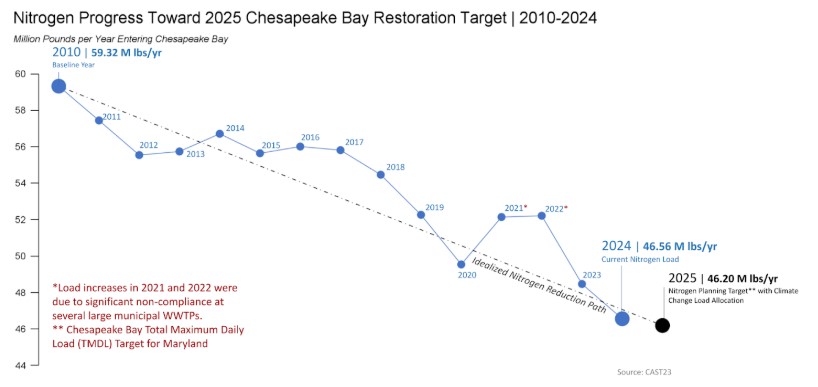
Maryland met 97% of its Phase III Watershed Improvement Plan nitrogen reduction goal. Via the Maryland Department of the Environment
With these successes and with ongoing planning, Maryland is well positioned to meet the updated goals of the revised agreement. The state is preparing for the next three large-scale oyster restoration projects. Planning is also underway for mussel restoration in the state, with the state’s mussel hatchery taking lessons from the oyster restoration projects and supported by funding through the Conowingo Dam settlement with Exelon.
The updated agreement aligns with Maryland’s new strategy for Bay restoration, which focuses on improvements to shallow waterways, such as streams, coastlines, and rivers—areas where people tend to have the most interaction with their watershed and places where targeted action can have large impacts. The five waterways supported by the Whole Watershed Act in Maryland will be test cases in how focused water quality improvement projects in a specific area can benefit habitats, communities, and economic opportunities.
The Chesapeake Bay Executive Council met Tuesday at the National Aquarium in Baltimore to approve the revised agreement, setting the path for the next 15 years of environmental action in the Bay region, where the council selected Pennsylvania Governor Josh Shapiro as the next chair of the Executive Council. Governor Shapiro will take over from Governor Moore, who led the Executive Council for the previous two years.
